 [Anacardium occidentale]
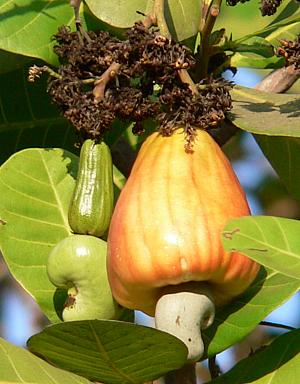
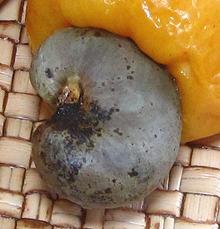
The Cashew is native to Brazil, which is still a major grower, though long overshadowed by India which has itself been eclipsed by Vietnam, with Ivory Coast and other parts of Africa catching up. Looking at the photo to the left you can see the true fruit, shaped like a cashew nut, with a false fruit, the "cashew apple" above it.
Cashews are never shipped "in the shell" because the "shell", the fruit wall, is laced with dangerous levels of the irritant urushiol. Cashews must be shelled and prepared with great care to prevent toxicity. While rare, there have been cases where cans of nuts contaminated with pieces of shell have caused mass rash breakouts.
The "cashew apple" is edible but used fresh mostly locally because it
is tender and highly perishable, starting to ferment within 24 hours.
It is used mainly to make jams, juice, or fermented and distilled into
alcoholic beverages.
Photo by S.Ballal distributed under license Creative Commons
Attribution-ShareAlike v2.5.
There is also an Australian cashew, Semecarpus australiensis with a similar structure and requiring similar care in handling, but it has a very small apple and lacks the "cashew curve". It is used mainly as "bush food" by the Australian aborigines, who handle it with great care and mud coated hands.
More in Cashews / Mangos
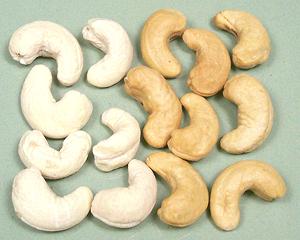 Actually seeds, Cashews are
familiar to Americans roasted, salted and often mixed in with nuts.
Despite their Brazilian origin, cashews are much used in Asian cooking.
In India they are most often ground as a thickener, but sometimes used
as a feature ingredient. In Southeast Asia, they are often used whole
in various dishes. For cooking you generally want to use the "raw"
version. They are often dry pan roasted until spotted brown and the
flavor has changed, but these are very different in taste and texture
from the heavily oven roasted snack nuts. Of course, they are similarly
used in Brazil, but the "apple" has traditionally been more used there.
Actually seeds, Cashews are
familiar to Americans roasted, salted and often mixed in with nuts.
Despite their Brazilian origin, cashews are much used in Asian cooking.
In India they are most often ground as a thickener, but sometimes used
as a feature ingredient. In Southeast Asia, they are often used whole
in various dishes. For cooking you generally want to use the "raw"
version. They are often dry pan roasted until spotted brown and the
flavor has changed, but these are very different in taste and texture
from the heavily oven roasted snack nuts. Of course, they are similarly
used in Brazil, but the "apple" has traditionally been more used there.
Because heat, usually roasting, is generally used to safely remove the
cashew from its shell without injury or toxic contamination, "raw" usually
means "not roasted after shelling". I understand there is a company in
Indonesia with special equipment that can extract cashews safely without
heat for sale to people following a strict raw foods diet - at a premium
price, of course.
 [Marañon (Spanish)]
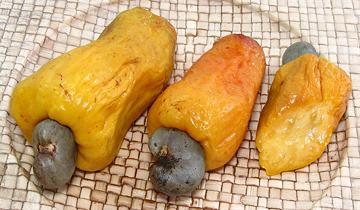
The "Apple" is an "Accessory Fruit" (formerly "False Fruit). The true fruit is the multi-layered "shell" surrounding the nut, and the "apple" is a swollen flower stem (pedicel). The tree's strategy is that animals will carry off the fruit to new locations, but will avoid biting into the actual fruit surrounding the seed. These "apples" are very tender, so not often sent far from the growing region, where they may be used in many ways.
I purchased the photo specimens, frozen, from a large market in
Los Angeles (Burbank) serving South and Central American and Mexican
communities. The largest was 4-1/8 inches long (not counting the nut)
and 2 inches diameter at the large end, weighing 6-1/4 ounces. The
flesh was very tasty, but too fibrous to eat, so, juice.
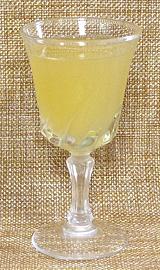
When examining the Cashew Apples in the photo above, I found the flesh far too fibrous for eating, so I chopped them up and squeezed them for juice. The juice was very pleasant, kind of like a mix of mango and peach, and needed no sweetening. 14 ounces of fruit yielded 6 ounces of juice (43%), but it could have been more because some was lost messing around studying the fruit, and I could have chopped it finer and pressed it harder.
Where cashews are harvested, this juice is often fermented, then
single distilled to about 15% alcohol, or double distilled to over
40% alcohol. In Brazil, unfermented cashew juice is used for a very
popular mixed drink called Caju Amigo (Cashew Friend). It's 50% Cashew
Juice and 50% Cachaça (Brazilian rum, 48% alcohol). Ice is
sometimes added. This is also done by chewing a slice of Cashew Apple,
then swallowing the juice (only) with a sip of Cachaça. Cashew
Apple Juice can often be found in markets serving a community from the
American tropics.
 You probably don't want to
mess with these. The shell is very tough, and, between the inner
and outer layers it is full of extremely flammable oils laced with
dangerous quantities of urushiol, the irritant found in poison ivy.
They are roasted over flame, and the oils ignite into a raging blaze,
which must be put out in 10 minutes or the cashew seeds will burn.
Most, but not all the urushiol will have been destroyed.
You probably don't want to
mess with these. The shell is very tough, and, between the inner
and outer layers it is full of extremely flammable oils laced with
dangerous quantities of urushiol, the irritant found in poison ivy.
They are roasted over flame, and the oils ignite into a raging blaze,
which must be put out in 10 minutes or the cashew seeds will burn.
Most, but not all the urushiol will have been destroyed.
In Vietnam, India and Africa, people employed in shelling cashews
often suffer seriously from these oils. The oils do have many important
industrial applications and some byproducts are used in frictional
applications like brake pads. Leave these to the industries for which
they have value.
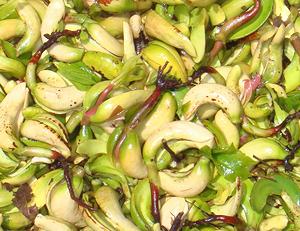 You are unlikely to find these
sprouts in your local natural foods store. In tropical India,
particularly the state of Karala, they are gathered from the ground after
the monsoon rains, or from late dropping fruits at the end of harvest
time. They are not usually marketed, but used in the homes of the
gatherers. They can be eaten raw, but are often used as an ingredient
in curries, where they are said to taste similar to mushrooms.
Photo by Malayalam loves Wikimedia event distributed under license
Creative Commons
Attribution-ShareAlike v3.0 unported.
You are unlikely to find these
sprouts in your local natural foods store. In tropical India,
particularly the state of Karala, they are gathered from the ground after
the monsoon rains, or from late dropping fruits at the end of harvest
time. They are not usually marketed, but used in the homes of the
gatherers. They can be eaten raw, but are often used as an ingredient
in curries, where they are said to taste similar to mushrooms.
Photo by Malayalam loves Wikimedia event distributed under license
Creative Commons
Attribution-ShareAlike v3.0 unported.